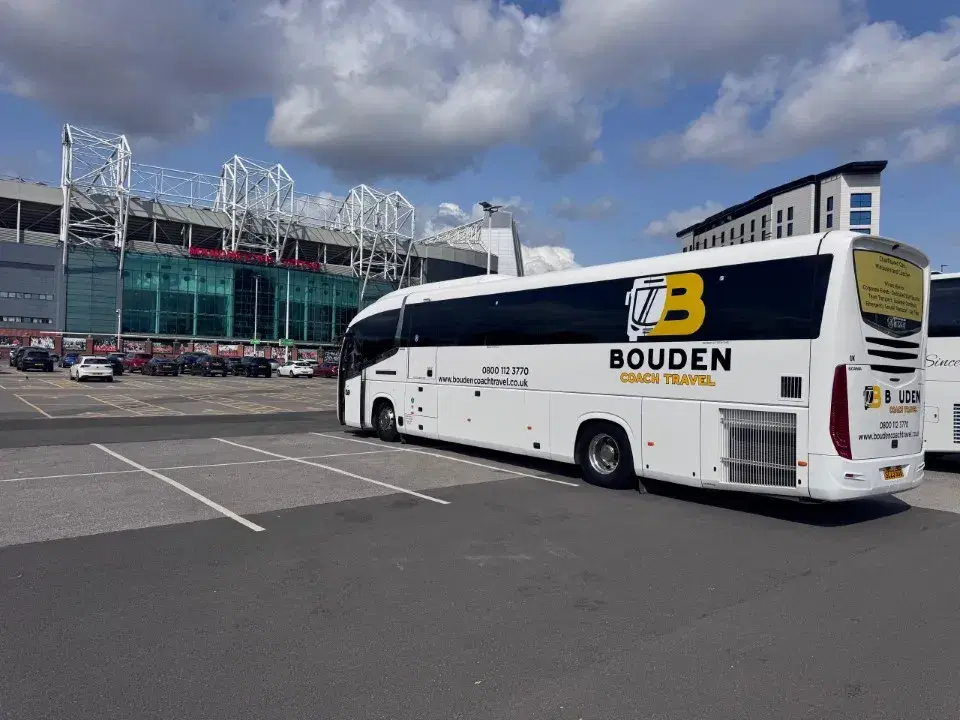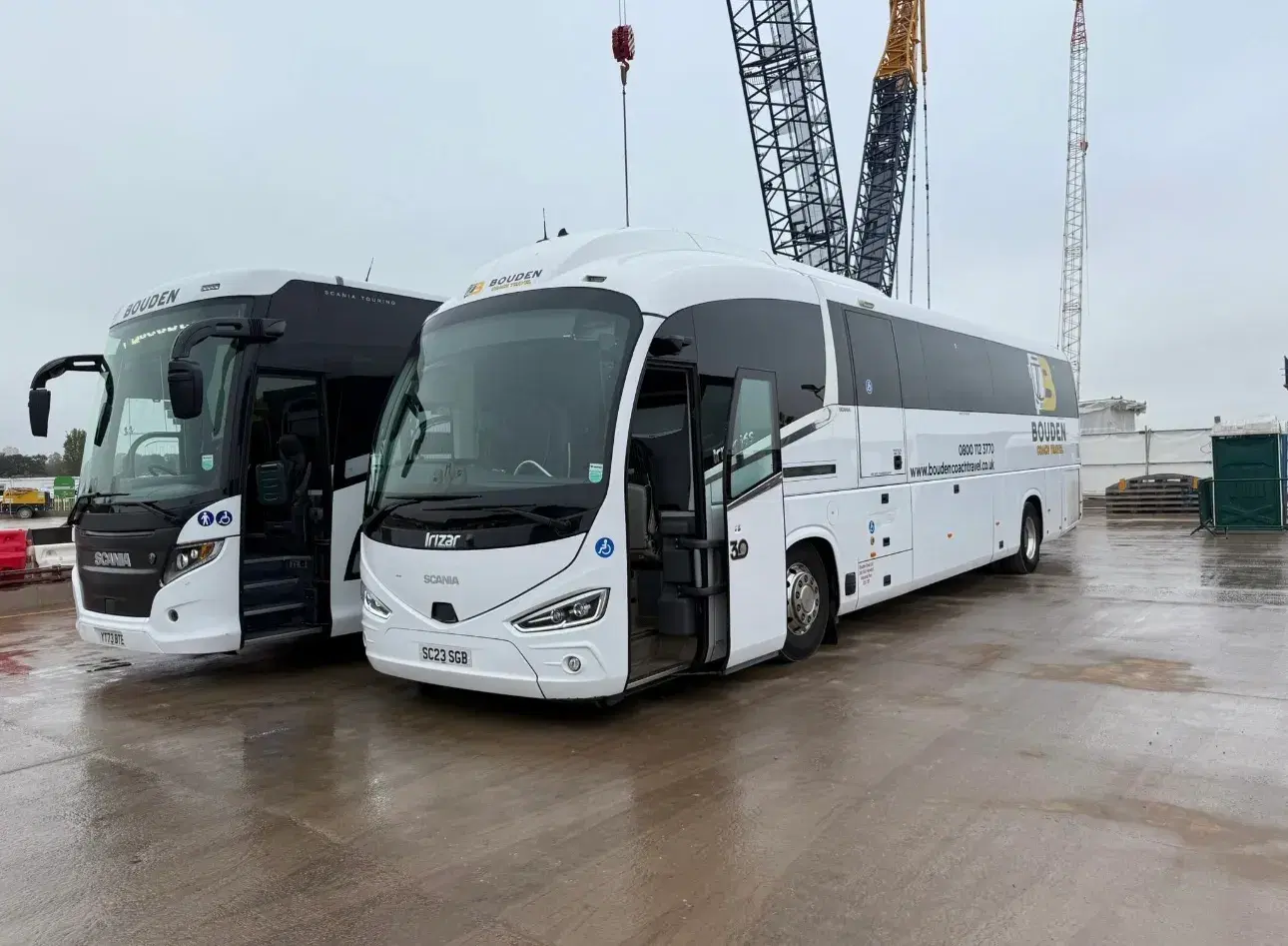
A staff shuttle bus service is a scheduled, driver-led bus or coach that carries employees between agreed pick-up points and their workplace. Employers in Birmingham use them when a site is hard to reach by public transport, when shift times fall outside normal bus and rail hours, or when car parking has run out. Set up properly, a shuttle removes the daily lottery of whether people can physically get to work.
This guide covers when a shuttle is worth the money, how to size and route one, the UK tax and compliance points employers most often miss, and what to put in an enquiry so the quotes you get back are comparable.
What is a staff shuttle bus service?
A staff shuttle bus service is a private, timetabled transport service provided by an employer for its workforce, usually between transport hubs, residential pick-up points or park and ride sites and the workplace. It runs to a fixed schedule on agreed days, uses a professional driver, and is closed to the public.
The important distinction is that a staff shuttle is a contract, not a one-off booking. You are buying a repeating service with guaranteed vehicles and drivers, so pricing, planning and compliance all work differently from hiring a coach for a single trip.
Which Birmingham employers use staff shuttles?
Four groups account for most staff shuttle demand in Birmingham and the West Midlands.
- Warehousing, logistics and manufacturing. Sites around Minworth, Hams Hall, Tyseley, Witton and the Aston and Erdington industrial belt often sit outside useful bus coverage, and shift changes at 6am, 2pm and 10pm rarely line up with timetabled services.
- Construction and infrastructure. Large sites restrict on-site parking, sometimes as a planning condition. A shuttle from a remote compound or a city centre meeting point keeps vehicle movements down and site access controlled.
- Corporate campuses and office relocations. Employers around Birmingham Business Park, the airport and NEC corridor, and out-of-town parks use shuttles to link offices to Birmingham New Street, Birmingham International or a park and ride site.
- NHS trusts, councils and universities. Multi-site organisations run staff shuttles between hospitals, depots and campuses, often alongside patient or student transport under the same contract.
Birmingham's commuting pattern explains the demand. At the 2021 Census, driving a car or van was the most common way Birmingham residents travelled to work, at 45.9 per cent, while bus, minibus or coach accounted for 9.7 per cent. The census was taken in March 2021 during pandemic restrictions, so the home working figures are unusually high, but the reliance on the car is long-standing.
When does a staff shuttle actually pay for itself?
A staff shuttle usually justifies its cost when the alternative is unfilled shifts, expensive parking, repeated taxi claims, or a recruitment pool limited to people who own a car. It rarely pays for itself on comfort alone. The business case is normally built on retention, punctuality and access to labour.
Run the numbers against these questions before you commit.
- How many shifts a month are late or unfilled because of transport?
- What are you already spending on taxis, mileage claims, overtime cover and agency staff to plug those gaps?
- What does an additional parking space cost you, or what would expanding the car park cost?
- How far does your recruitment radius shrink if candidates need their own car?
- What are the CO2 and sustainability reporting implications of dozens of single-occupancy car journeys a day?
If two or three of those have a real number attached, a shuttle is usually worth pricing.
What drives the cost of a staff shuttle contract?
Contract pricing is built from the vehicle, the driver hours and the mileage, not from a headline day rate. These are the factors that move the price most.
| Factor | Effect on price |
|---|---|
| Vehicle size | Larger vehicles cost more per journey but usually far less per seat. |
| Hours of operation | Early mornings, nights and weekends carry higher driver costs. |
| Dead mileage | Distance between the depot and your first pick-up is chargeable time. A local operator reduces it. |
| Number of pick-up points | Every extra stop adds running time and makes the timetable harder to hold. |
| Split shifts | A morning run and an evening run with a long gap can mean paying for driver downtime unless the vehicle is used elsewhere. |
| Contract length | Longer commitments support better rates because vehicles and drivers can be planned properly. |
| Accessibility requirements | Wheelchair-accessible vehicles are a specific fleet type and need to be specified up front. |
For general market context on vehicle rates, see our guide to coach hire prices in the UK. Contract shuttle pricing is quoted separately because the economics of a repeating service are different from a one-off hire.
What size vehicle do you need for a staff shuttle?
Size the vehicle to the busiest single movement you need to cover, not to your total headcount. A site with 200 staff across three shifts might only need to move 35 people at once. Building the timetable around peak load rather than headcount is the single biggest cost lever you control.
| Vehicle | Capacity | Typical shuttle use |
|---|---|---|
| MPV | 6 to 8 passengers | Small teams, key staff, out of hours cover |
| Minibus | 8 to 16 passengers | Single site runs, small shifts, feeder routes to a main pick-up |
| Midi coach | 20 to 32 passengers | Main shift movements on mid-sized sites |
| Large coach | 32 to 49 passengers | Full shift changes and park and ride operations |
| Double decker | 50 to 70 passengers | High volume movements on a single run |
If demand sits awkwardly between two sizes, ask your operator to price both. Our guide on choosing the right coach size goes into the trade-offs in more detail, and you can compare specifications across our vehicle types.
How to design a shuttle route and timetable that works
Most shuttle services that fail do so because the timetable was designed around the vehicle rather than around the shift. Work through these steps in order.
- Map where your people actually live. Use postcode data from your HR system, aggregated and anonymised. You are looking for clusters, not individual addresses, and you should handle this in line with your data protection obligations.
- Fix the arrival time first. Work backwards from the shift start, allowing a buffer for site access, security and clocking in. Ten minutes of slack at the site end prevents most late starts.
- Limit pick-up points. Two or three well-chosen stops beat six marginal ones. Transport hubs, park and ride sites and a small number of residential clusters usually cover the majority of demand.
- Check the route at the real time of day. A route that works at 10am may not work at 7.30am. The A38, A45 and the A4540 Middleway all behave very differently at peak.
- Plan the return leg properly. Overrunning shifts are normal. Agree in advance what happens if the shift runs late and who pays for waiting time.
- Pilot before you commit. Run a four to six week trial, record actual loadings and punctuality, then size the permanent contract on evidence.
- Review quarterly. Headcount, shift patterns and roadworks all change. A shuttle that is never reviewed slowly stops matching demand.
One practical warning. Staff will vote with their feet in the first fortnight. If the first week is late or the vehicle is too small, take-up collapses and it is hard to recover, so over-specify slightly at launch rather than trimming to the bone.
The UK rules employers get wrong
Staff transport sits across tax, employment and transport law. These are the four points that most often come up late in a procurement process.
Is a staff shuttle bus a taxable benefit for employees?
Not if it meets HMRC's works bus conditions. Under section 242 of the Income Tax (Earnings and Pensions) Act 2003, a works transport service is exempt from income tax where the vehicle is a bus with a seating capacity of 12 or more, or a minibus seating 9 to 11, the service is available generally to employees, and it is mainly used for qualifying journeys such as home to workplace on a normal working day. Where the conditions are met there is no benefit in kind to report on a P11D.
That seating capacity threshold matters. A shuttle run in a people carrier or a car will not qualify as a works bus, however genuine the arrangement. Confirm your specific set-up with your accountant or tax adviser before you rely on the exemption, and keep records showing the service was open to staff generally.
Do accessibility regulations apply to a staff shuttle?
Usually not in the way people expect. The Public Service Vehicles Accessibility Regulations apply to vehicles designed to carry more than 22 passengers used on local or scheduled services, and closed private hire work generally falls outside them. That does not remove your obligations as an employer. Your duty to make reasonable adjustments under the Equality Act 2010 still applies to how staff get to and around work.
In practice, ask your operator directly whether wheelchair-accessible vehicles are available on your contract and what notice they need. Bouden Coach Travel operates PSVAR-compliant wheelchair-accessible vehicles, and it is far easier to specify this at tender stage than to retrofit it later.
How do drivers' hours rules affect a shuttle timetable?
They affect it more than most employers expect. Passenger services on regular routes not exceeding 50km are exempt from the assimilated EU drivers' hours rules and instead fall under the GB domestic rules. Longer or irregular routes bring the assimilated rules and tachograph requirements into play, which changes how driver shifts, breaks and rest must be planned.
The practical consequence is that a split shift with a long unpaid gap in the middle is not always legally or commercially straightforward. A good operator will tell you this at quoting stage rather than after the contract starts.
What licensing and vetting should you insist on?
Ask for evidence rather than assurances. At minimum you should see the operator's PSV operator licence details, confirmation of insurance cover and limits, driver CPC qualification, and DBS checks where your site or sector requires them. For construction, healthcare and education sites, check what site-specific inductions or additional vetting your own policies demand, and build the lead time for that into the mobilisation plan.
Birmingham specifics: the Clean Air Zone and the Middleway
Birmingham operates a Clean Air Zone covering the city centre inside the A4540 Middleway, running 24 hours a day, every day of the year. Non-compliant vehicles pay a daily charge, with different rates for cars and for larger vehicles. Rates and exemptions are set by Birmingham City Council and have been reviewed since launch, so check the current figures on the council's website rather than relying on a number you saw last year.
For employers the logic is simple. If staff drive individually into or through the zone, each non-compliant vehicle can attract a charge every day. A single compliant coach or minibus replaces dozens of those journeys. When you tender, ask your operator to confirm the emissions compliance of the vehicles allocated to your contract, in writing.
The Middleway also matters operationally. Pick-up points just outside it can be quicker and cheaper to serve than points inside it, particularly at peak.
What to include in your staff transport enquiry
Quotes are only comparable if every operator is pricing the same thing. Send all of this with your enquiry.
- Site address and any access restrictions, including gate times and turning constraints for large vehicles.
- Shift start and finish times, and the days of the week the service runs.
- Expected passenger numbers per movement, and your confidence level in that figure.
- Proposed pick-up points, or the postcode clusters you want covered.
- Contract length and the start date you need.
- Accessibility requirements.
- Any vetting, induction or site safety requirements for drivers.
- Invoicing and reporting requirements, including whether you need usage or punctuality data.
- What you expect to happen if a vehicle breaks down or a shift overruns.
That last point separates serious operators from the rest. Ask specifically what the backup arrangement is and how quickly a replacement vehicle can reach your site.
If you are ready to price a service, you can request a tailored staff transport quote and select "Staff Shuttles or Transport" as the journey type so the enquiry reaches our contracts team directly.
How Bouden Coach Travel runs staff shuttle services
We provide staff shuttles and employee transport as part of our contract and long-term transport services, alongside NHS and council contracts, university and school transport, and industrial site and construction worker transport.
Contract clients get a dedicated account manager, service level agreements with backup vehicle availability, 24/7 operational support, consolidated invoicing and reporting on usage and performance. Vehicles range from MPVs and minibuses through to midi coaches, full-size coaches and double deckers, so a contract can be re-sized as your headcount changes rather than being locked to one vehicle type.
We are based at Unit 18, Haywards Industrial Park, Orton Way, Birmingham B35 7BT, a few minutes from Birmingham Airport and the M6. For sites in north and east Birmingham, Solihull, Castle Vale, Minworth and the airport corridor, that keeps dead mileage low, which shows up directly in the contract price. Drivers are DBS-checked and CPC-qualified, and we hold DVSA certification along with CPT and RHA membership.
For one-off business travel rather than a repeating service, see our corporate and business travel options or our article on corporate coach hire in Birmingham.
Staff shuttle bus FAQs
How much does a staff shuttle bus service cost in Birmingham?
There is no standard rate, because contract pricing is built from vehicle size, driver hours, mileage and how many days a week the service runs. The main cost levers are the size of vehicle you need for your busiest movement, the hours it operates, and how far the vehicle travels from the depot before its first pick-up. Ask for a quote based on your actual shift pattern.
What is the minimum number of staff needed to run a shuttle?
There is no legal minimum, but a shuttle usually makes commercial sense from around 8 to 16 regular passengers per movement, which is minibus capacity. Below that, taxis or mileage payments are often cheaper. Above about 30 passengers per movement, a midi or full-size coach normally gives a better cost per seat.
Is a staff shuttle bus a taxable benefit in the UK?
Not if it meets HMRC's works bus conditions under section 242 ITEPA 2003. The vehicle must be a bus seating 12 or more, or a minibus seating 9 to 11, the service must be available generally to employees, and it must be mainly used for qualifying journeys such as home to workplace on a working day. Where those conditions are met there is no benefit in kind to report. Confirm your arrangement with your tax adviser.
Can a staff shuttle run for night shifts and weekends?
Yes. Night and weekend running is common for warehousing, logistics, manufacturing and healthcare, and it is often where a shuttle delivers the most value because public transport is thin or absent. Driver costs are higher outside normal hours, so build those times into the quote rather than adding them later.
Can we change the route or timetable during the contract?
Yes, with reasonable notice. Headcount, shift patterns and roadworks change, so contracts should include a review mechanism. Agree at the outset how much notice is needed for a timetable change and whether a change in vehicle size affects the rate.
Do you provide wheelchair-accessible staff transport?
Yes. PSVAR-compliant wheelchair-accessible vehicles are available and should be specified when you request your quote so the right vehicle is allocated to the contract from the start rather than arranged as an exception.
Next steps
If you are weighing up staff transport for a Birmingham site, the quickest way to get a realistic answer is to send your shift times, expected passenger numbers and site address for pricing. We will come back with a proposed vehicle, a timetable that fits the shift, and a clear contract price.
Request a tailored staff transport quote, call 0800 112 3770, or contact our Birmingham team to talk through a route before you commit to anything.